
A customer calls and asks for 40 cartons of floor cleaner. Your register says you have 52. The storekeeper walks to the back of the godown and finds 31.
Nobody stole 21 cartons. Twelve went to the shop last week without a slip. Six are sitting behind the paint drums where no one looks. Three were damaged in the last monsoon and never written off.
That is what weak godown management looks like on an ordinary day. It is rarely one big loss. It is a slow drift between what the books say and what is on the floor, and you pay for it in missed orders, double purchases, and arguments with staff.
The stakes are real. Wholesale and retail trade made up 17.8 percent of Pakistan’s GDP in fiscal year 2025-26, according to the Pakistan Economic Survey 2025-26. Almost everything that trade sells waits in a godown, a store room, or a warehouse before it reaches a customer.
This guide shows you how to manage a godown properly, whether you run a kiryana store with a back room, a hardware shop with a godown across the road, or a distribution business with stock in three cities. You will get a rack numbering method, a receiving checklist, a transfer slip format, a stock register layout, and a counting schedule you can start using this week.
What Is Godown Management?
Godown management is the daily work of receiving, storing, moving, and counting the stock you keep in a godown so that your records match what is physically there.
A well-run godown can answer four questions at any moment:
- How many units of each item do we have?
- Where exactly is each item kept?
- Who received it, moved it, or sent it out, and when?
- When was it last counted, and did the count match the record?
If you can answer all four without phoning the one person who “knows the godown,” your system is working. If you cannot, the steps below will get you there.
Is a godown different from a warehouse?
Not in any way that changes how you run it. “Godown” is the everyday word in Pakistan and across South Asia for a building where goods are stored. “Warehouse” means the same thing, although people usually save it for larger sites with pallet racks and forklifts. Everything in this guide applies to both.
Signs Your Godown Needs a Better System
Most owners notice the symptoms long before they name the cause. It is time to tighten things up if any of these sound familiar:
- The register and the physical stock disagree, and nobody can explain the gap.
- Only one employee knows where things are, and work slows down whenever that person is on leave.
- You reorder an item, then find two cartons of it hidden behind something else.
- Stock goes to the shop on a phone call, with nothing written down.
- Damaged or outdated goods sit in corners and are still counted as sellable.
- The annual count takes two days, shows large differences, and changes nothing afterward.
None of these problems needs expensive equipment. They need a layout, labels, and a few records that are filled in every single time. If shortages are a regular headache, our guide to preventing inventory loss and stock leakage explains the common causes in more detail.
How to Manage a Godown in 7 Steps
1. Divide the godown into clear zones
Before you buy racks or software, walk the floor and decide what happens where. Even a small godown should have five areas:
- A receiving area near the shutter, where new stock is unloaded and checked.
- Main storage, meaning the racks and floor stacks where goods stay.
- A fast-moving section close to the door for the items you issue every day.
- A dispatch area where orders are put together before they leave.
- A damaged and returns corner, kept apart so bad stock never mixes with good.
Mark the zones with paint or tape on the floor. A painted line is often the only thing that stops a new delivery from being dumped in the aisle “just for now.”
2. Number every rack, shelf, and bin
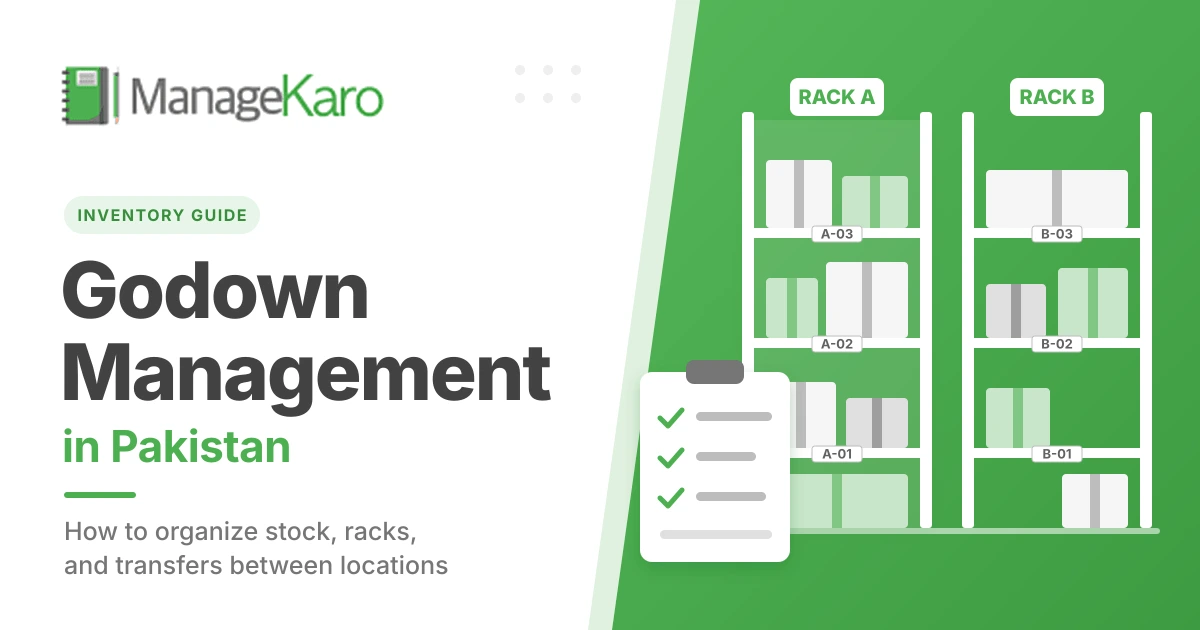
“The third rack on the left, near the fan” is not an address. A location code is. Give every storage spot a short code built from four parts.
| Part | What it tells you | Example |
|---|---|---|
| Godown | Which building or room | G1 |
| Rack | The rack or row, lettered from the entrance | A |
| Shelf | The level, numbered from the floor up | 03 |
| Bin | The position on that shelf, counted from the left | 2 |
| Full location code | Where the item lives | G1-A-03-2 |
A few rules keep the codes useful:
- Letter the racks in the order you reach them when you walk in.
- Number shelves from the bottom, so that adding a top shelf later does not change the old numbers.
- Paint or print the labels large enough to read from the aisle.
- Write the location code next to each item in your register or software, and update it whenever the item moves.
Once the codes are in place, a new helper can find any item on day one without asking. That matters most in trades with thousands of look-alike items, such as hardware, sanitary fittings, and auto parts. Our guide on how to manage inventory in a hardware store shows how this works for one of those trades.
3. Check every delivery before it goes on a rack
Mistakes that enter at the shutter stay in your books for months. When a supplier’s vehicle arrives, follow the same routine every time:
- Keep the goods in the receiving area until they have been checked.
- Count the cartons against the supplier’s bill or delivery challan.
- Open a few cartons and look for damage, leaks, or wrong items.
- Record the quantity that actually arrived, not the quantity printed on the bill.
- Write any shortage or damage on the supplier’s copy and have the driver sign it.
- Move the stock to its rack and note the location code.
If the bill says 100 cartons and you count 96, enter 96 and call the supplier the same day. Entering 100 to keep the paperwork tidy is how a register starts lying to you. Careful receiving is also the first half of sound purchase management.
4. Store stock by how fast it sells
Put your fastest-moving items closest to the dispatch area, between knee and shoulder height, where they are quick to pick. Slow sellers can go higher up or deeper inside.
A few storage habits prevent most damage:
- Keep heavy cartons and drums on the floor or the lowest shelf.
- Place new stock behind old stock so that the oldest is sold first.
- Keep the aisles empty at all times, even during a busy delivery.
- Stack bags of cement, flour, or fertilizer on pallets, away from walls that turn damp in the monsoon.
Tidy storage is also a safety matter. The U.S. Occupational Safety and Health Administration gives similar advice in its warehouse storage guidance: stored materials should not create a hazard, loose items should be stacked so they cannot fall, and storage areas should be kept clear.
5. Never move stock without a transfer record
In many Pakistani businesses, the biggest gap sits between the godown and the shop. The shop runs short, someone phones the godown, a loader rickshaw brings ten cartons, and nothing is written anywhere. By the end of the month, neither location’s figures can be trusted.
The fix is a transfer slip, made in duplicate. Every movement gets one, however small.
| Field on the slip | Why it matters |
|---|---|
| Slip number and date | Lets you trace the transfer later |
| From and to | For example, Main Godown to Shop |
| Item and location code | Shows exactly what was taken and from where |
| Quantity sent, with the sender’s signature | The godown’s proof of what left |
| Quantity received, with the receiver’s signature | The shop’s proof of what arrived |
The receiver must count before signing. If the slip says 10 cartons and 9 arrive, the difference is found that day, at the door, with both people present. Goods going out to customers deserve the same care, and a delivery challan does that job for outbound orders.
6. Count a little every week
A once-a-year stock count finds problems too late to explain them. Cycle counting works better. You count a small part of the godown each week, so the whole stock is covered over time and errors are caught while people still remember what happened.
| Type of stock | Examples | How often to count |
|---|---|---|
| Fast-moving or high-value | Your top 20 sellers and costly items | Every week |
| Regular | Steady sellers | Every month |
| Slow-moving | Seasonal or rarely requested items | Every three months |
| Everything | A full physical count | Once a year, before you close your books |
Two rules make the counts worth the effort:
- Count blind. Give the counter a list of items and locations without the expected quantities, so the count reflects what is on the shelf and not what the book says.
- Find the reason before you fix the number. Look for unrecorded transfers, items in the wrong bin, and damaged goods. If you only correct the figure, the same difference will be back next month.
7. Make one person responsible and limit access
Stock disappears fastest from a godown that anyone can walk into. Appoint one storekeeper for each godown, and have that person sign for everything that comes in or goes out.
- Lock the godown outside working hours and keep a note of who holds the keys.
- Let nothing leave without a transfer slip, a challan, or a bill.
- Issue a gate pass for every loaded vehicle, listing the vehicle number, the driver, and the goods.
- Ask someone other than the storekeeper to do the counts, so nobody checks their own work.
What to Record in a Godown Stock Register
Whether you keep it on paper, in Excel, or in software, a godown stock register needs the same columns.
| Column | What to write |
|---|---|
| Date | The day the stock moved |
| Item code and name | One fixed name per item, used by everyone |
| Location | The rack code, such as G1-A-03-2 |
| Quantity in | Stock received from a supplier, returned by a customer, or transferred in |
| Quantity out | Stock sold, sent to the shop, transferred out, or written off as damaged |
| Balance | What is left after the entry |
| Reference | The bill, challan, or transfer slip number |
| Entered by | A name or signature |
Make the entry at the moment the stock moves, not from memory at closing time. Give each item a single name, too. If one person writes “PVC pipe 1 inch” and another writes “one-inch PVC,” you will end up with two records for the same product and a balance that is wrong in both.
On paper, the simplest method is one page per item. Many storekeepers also hang a bin card on the rack itself. It is a small card that shows that item’s ins, outs, and balance, and it makes spot checks quick.
Managing More Than One Godown
A second godown doubles the ways stock can go wrong. These rules keep several locations under control:
- Keep a separate balance for each location. A total of 500 pieces helps nobody if 480 of them are in another city.
- Use the same item codes and names everywhere.
- Treat every movement between locations as a transfer with a slip, even between two godowns on the same street.
- Check the other godown before you buy. Paying for stock you already own is a common and quiet waste of cash.
- Review slow stock location by location. An item that sits unsold in one branch may sell well in another.
This is the point where paper begins to struggle, because each godown has its own book and nobody sees the full picture. Our article on cloud inventory software for multi-location businesses looks at that problem closely. If you supply retailers, the page on inventory software for distributors is also worth a read.
Register, Excel, or Software: Which One Fits Your Godown?
| Method | Works well when | Where it breaks down |
|---|---|---|
| Paper register | You have one godown, a few hundred items, and one storekeeper | It is slow to search, entries get skipped, and there is no backup if the book is lost or damaged |
| Excel sheet | You have one or two locations and someone comfortable with spreadsheets | Only one person can update it at a time, formulas break, and sales do not reduce stock on their own |
| Inventory software | You have several locations, staff, and daily sales and transfers | It needs setup time and staff who record every movement |
No software can rescue a godown that has no labels and no discipline, so put the seven steps in place first. After that, the question is simply whether your current tool can keep up with the number of movements you make in a day. Our post on the signs you have outgrown Excel can help you judge that. And if you are comparing systems, look for inventory management software in Pakistan that handles godowns, racks, and transfers, not only billing.
How ManageKaro Supports Godown Management
ManageKaro is business management software for Pakistani retailers, wholesalers, and distributors. Its inventory module follows the same method this guide describes:
- Each godown, branch, and shop is set up as its own warehouse, with its own quantity for every item.
- Every item can be given a rack and a sub-rack inside a godown, so staff can look up where it is kept.
- A stock transfer records the items, the godown they left, and the location they went to.
- A sale billed through the POS reduces stock at the location that made the sale. You can read more about how POS sales and stock work together.
- When a delivery arrives, the quantity is added to the receiving godown and saved against the supplier.
- Low-stock alerts flag items that are running down.
- Delivery challans and vehicle gate passes are created in the delivery management module.
- Staff logins can be limited by location, so a branch storekeeper sees only that branch.
- The desktop app keeps working offline and syncs when the connection returns.
If your business depends on batch numbers, expiry dates, or selling the same item by the carton and by the piece, ask the ManageKaro team how those are handled before you subscribe.
You can test all of this on your own stock with a 3-day free trial. No credit card is required.
Frequently Asked Questions
What is godown management?
Godown management is the process of receiving, storing, moving, and counting the goods kept in a godown so that stock records match the physical stock. It covers layout, rack locations, receiving checks, transfers, and regular counts.
What is the difference between a godown and a warehouse?
There is no practical difference. “Godown” is the common term in Pakistan and South Asia, while “warehouse” is used worldwide and often suggests a larger, racked facility. Both are managed with the same methods.
How do I maintain a godown stock register?
Record every movement on the day it happens, with the date, item, location, quantity in or out, new balance, and a reference to the bill, challan, or transfer slip. Use one fixed name for each item and have the person making the entry sign it.
How often should godown stock be counted?
Count fast-moving and high-value items every week, regular items every month, and slow items every three months. Do one full count a year before you close your books.
How do I track stock sent from the godown to the shop?
Use a numbered transfer slip in duplicate. The godown writes the quantity sent and signs, and the shop counts the goods, writes the quantity received, and signs. Both locations then update their stock from the same slip.
Can I manage more than one godown in one system?
Yes. Inventory software with multi-location support keeps a separate balance for each godown and records transfers between them. In ManageKaro, one account can hold several warehouses, each with its own stock.
Where to Start This Week
You do not need to change everything at once. Pick one rack. Empty it, clean it, label the shelves, put the stock back in order, count it, and write down the result. Tomorrow, start using transfer slips for everything that leaves for the shop.
Keep going one rack at a time. Within a month or two, every shelf can have a code, your register can match the floor, and the next call about 40 cartons will take one minute to answer.


4 thoughts on “Godown Management in Pakistan: How to Organize Stock, Racks, and Transfers”