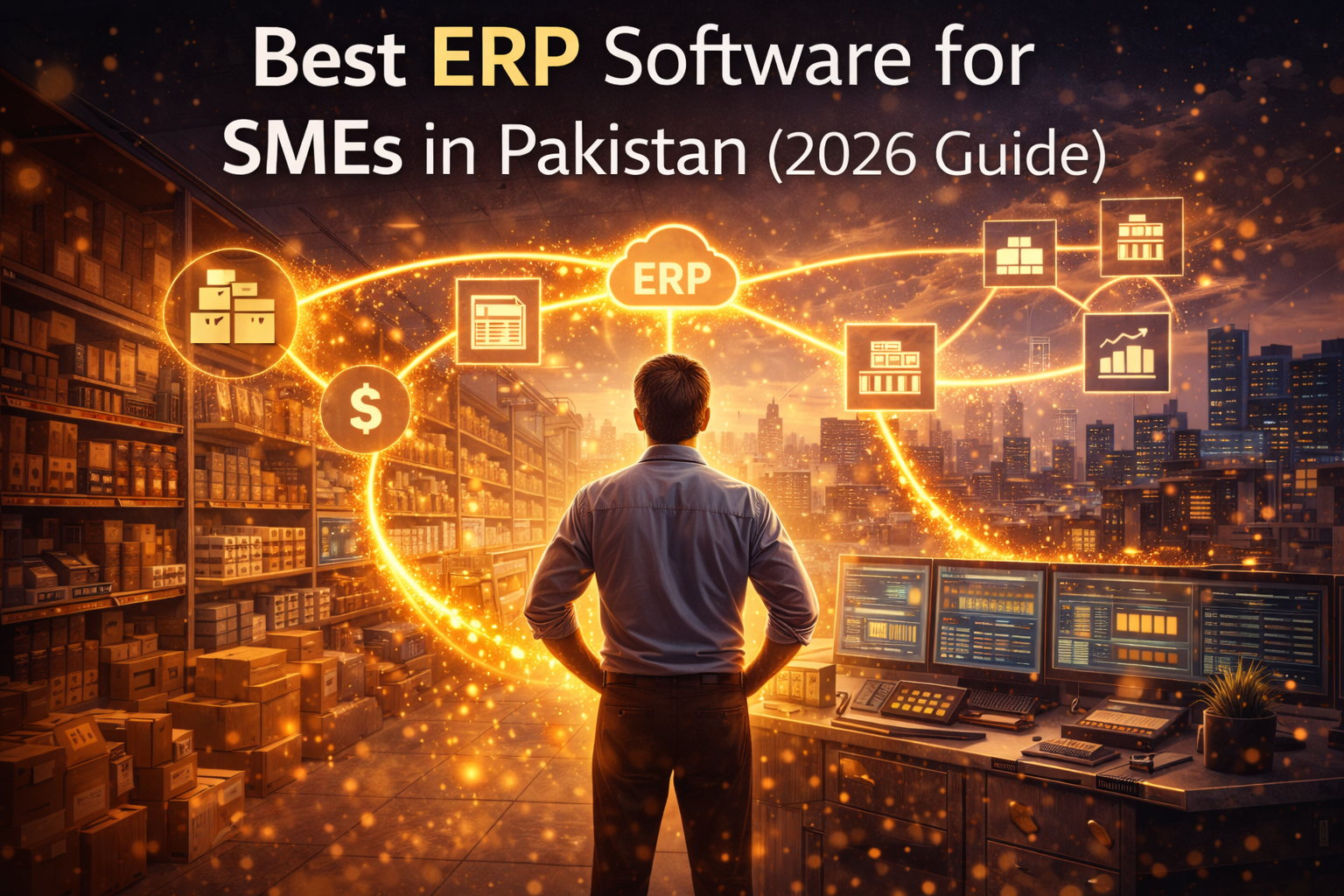
As businesses in Pakistan grow, managing operations becomes more complex.
Inventory expands.
Staff increases.
Branches multiply.
Financial visibility becomes critical.
This is where ERP software for SMEs becomes essential.
In 2026, ERP systems are helping Pakistani businesses centralize operations, reduce manual work, and scale efficiently.
Let’s explore the best ERP options available today.
What Is ERP Software?
ERP stands for Enterprise Resource Planning.
ERP systems integrate multiple business functions into one platform.
Typical ERP modules include:
- Billing and invoicing
- Inventory management
- Accounting
- Purchasing and suppliers
- Staff access control
- Business reporting
Instead of using separate tools, ERP centralizes everything.
Why SMEs in Pakistan Are Adopting ERP
Small businesses traditionally rely on:
- spreadsheets
- billing software
- manual accounting
As operations grow, these tools create challenges.
ERP systems help solve:
- inventory mismatches
- financial confusion
- branch coordination problems
- reporting delays
This is why ERP adoption is increasing across Pakistani SMEs.
Top ERP Software for SMEs in Pakistan (2026)
1. ManageKaro
ManageKaro is designed specifically for SMEs in Pakistan.
Key features include:
- inventory management
- billing and POS integration
- multi-branch control
- financial reporting
- centralized dashboards
Best for:
Retailers, distributors, and growing SMEs.
2. SAP Business One
Enterprise-level ERP used globally.
Best for:
Large organizations and corporations.
Limitation:
Expensive for small businesses.
3. Odoo ERP
Modular ERP system with customization options.
Best for:
Businesses needing flexible modules.
Limitation:
Requires technical configuration.
4. Oracle NetSuite
Cloud-based enterprise ERP.
Best for:
Large companies.
Limitation:
High cost.
5. Microsoft Dynamics 365
Comprehensive ERP ecosystem.
Best for:
Enterprise-level businesses.
Limitation:
Complex setup.
How to Choose ERP for Your Business
When selecting ERP software, SMEs should evaluate:
- scalability
- inventory management strength
- financial reporting
- multi-branch capabilities
- ease of use
The right ERP should simplify operations, not complicate them.
When Businesses Should Upgrade to ERP
Businesses should consider ERP when:
- inventory errors increase
- multiple locations exist
- financial reports take too long
- operations rely on spreadsheets
ERP systems provide structure and visibility.
Final Thoughts
ERP software is no longer only for large enterprises.
In 2026, SMEs across Pakistan are adopting ERP systems to manage operations more efficiently.
Choosing the right ERP helps businesses gain control, improve decision-making, and support long-term growth.