
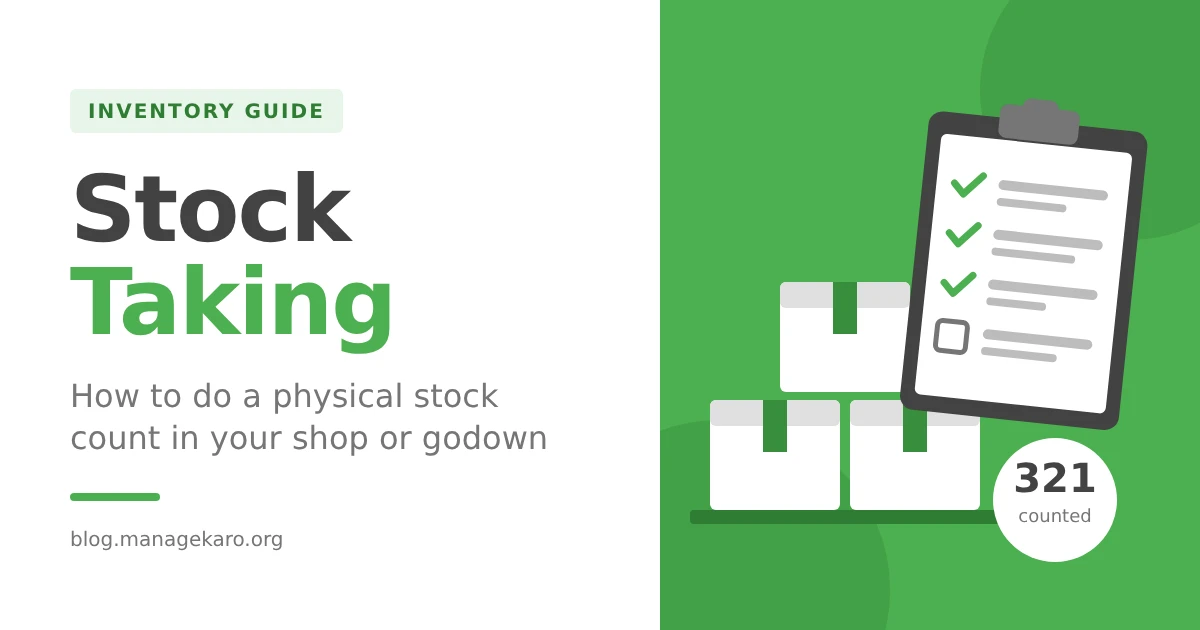
Your register says 345 pieces of bath soap. The shelf holds 321. Which number do you use when you reorder, quote a bulk price, or close your books for the year?
The shelf is right, and the only way to know what the shelf says is to count it. Most shop owners in Pakistan already count the cash drawer every night as part of their end-of-day cash reconciliation. Stock is money too, yet it often gets counted once a year, in a rush, with customers still walking in.
This guide walks you through a full stock take for a shop, a godown, or both. You will get a preparation checklist, a cut-off rule, a count sheet format you can copy, rules for cartons and loose goods, a worked variance example in rupees, and the steps for correcting your records afterward.
What Is Stock Taking?
Stock taking is the process of physically counting every item you hold for sale, writing down the counted quantities, and comparing them with your stock register or software. The differences show what has been lost, damaged, misplaced, or recorded wrongly, so you can correct the records and fix the cause.
You will also hear it called a stock take, a physical stock count, a physical inventory count, or stock verification. The names differ, but the job is the same.
How is a full stock take different from cycle counting?
A full stock take counts everything in one go, usually with sales stopped. Cycle counting covers a few racks or items each week, so the whole stock is checked over time. Most businesses need both: one full count a year and small weekly counts in between. The weekly schedule is set out in our godown management guide, so this article stays with the full count.
When Should You Do a Stock Take?
Do a full count at least once a year, and also at these moments:
- At your financial year end, so the closing stock in your accounts is a counted figure and not a guess. If your year ends on 30 June, count on that day or as close to it as you can.
- Before a busy season such as Ramadan and Eid, so you buy against real quantities.
- When a storekeeper or branch manager hands over to someone else, so the handover rests on a signed count.
- When you move from a paper register or Excel to software, because the opening stock you enter becomes the base for every later figure.
- Whenever the gap between records and shelves has grown so wide that staff no longer trust the system.
Businesses registered for sales tax have one more reason to keep count records in order. Section 22 of the Sales Tax Act, 1990 lists inventory records among the records a registered person making taxable supplies must maintain, and Section 24 requires records to be retained for six years after the end of the tax period they relate to.
What Do You Need to Prepare Before the Count?
Work through this checklist in the days before the count.
- Fix the date and time. Choose a day when the shop is closed or trade is slowest, and tell staff a week ahead.
- Bring the records up to date. Enter every purchase bill, sale, return, and transfer slip dated up to the count day.
- Tidy every rack, with each item in one place and labels facing the aisle.
- Move damaged, expired, and unsellable goods to one marked corner. They get their own count sheet.
- Tag goods that are not yours. Customer goods waiting for pickup, items held for repair, and stock a supplier has left with you on consignment should carry a “not our stock” tag.
- List your stock that sits elsewhere. Goods lent to another shop, samples with salesmen, and stock sent on approval still belong to you and must be added to the count. See our post on tracking loaned stock.
- Print numbered count sheets, one set for each rack or zone, and note who received which sheet numbers.
- Arrange clipboards, pens, stickers or chalk for marking counted shelves, and a weighing scale.
- Form two-person teams and give each team a zone. Nobody should count the area they look after every day.
How do you set a cut-off so nothing moves during the count?
The cut-off is the exact point that separates “before the count” from “after the count” in your paperwork.
Before the first item is counted, write down three numbers: the last sales bill number, the last purchase entry, and the last transfer slip number. Everything up to those numbers must be in the records. Everything after them belongs to the next period.
- Deliveries that arrive during the count stay in the receiving area with a “received after count” tag.
- Goods already billed but not yet collected are moved aside and tagged “sold, do not count.”
- If you cannot close for the day, sell only from a small counter stock that is counted first and recorded separately, and stop all movement between the godown and the shop until the count is finished.
What Should a Stock Count Sheet Include?
A count sheet is the form your teams fill in at the shelf. Keep it simple, and leave the expected quantity off it. When counters cannot see what the book says, they write what is actually there. This is called a blind count.
| Column | What to write |
|---|---|
| Sheet number and date | Printed in advance, so a missing sheet is noticed |
| Location | Godown, rack, and shelf, for example G1-A-03 |
| Item code and name | Exactly as it appears in your register or software |
| Unit | Piece, pack, carton, kg, or liter |
| Working | Cartons multiplied by pack size, plus loose pieces |
| Counted quantity | The total, in the unit your records use |
| Recount | Filled in only if the line is counted again |
| Counted by and checked by | Two names and two signatures |
| Remarks | Damaged, open carton, wrong label, or found in another rack |
Here is how three lines look when they are filled in.
| Location | Item | Unit | Working | Counted quantity | Remarks |
|---|---|---|---|---|---|
| G1-A-02 | Bath soap 150 g | Piece | 13 cartons x 24 + 9 | 321 | One carton open |
| G1-B-01 | Cooking oil 5 liter tin | Tin | 28 cartons x 4 + 2 | 114 | 2 tins dented, still sellable |
| G1-C-04 | Sugar, loose | kg | 9 bags x 50 + 42.5 | 492.5 | Open bag weighed |
How do you count cartons, loose pieces, and items sold by weight?
A unit mistake can turn a correct count into a wrong figure, so agree on the rules before you start.
- Count sealed cartons as cartons and multiply by the pack size printed on the carton. Then add the loose pieces.
- Treat any carton with a broken seal as loose stock. Open it and count the pieces.
- Weigh loose goods such as sugar, rice, pulses, and nails. Do not estimate from the level in the bag.
- Write the total in the same unit your records use. If the register is in pieces, a count written as “13 cartons” will look like a shortage of hundreds.
How to Do Stock Taking Step by Step
- Record the cut-off. Note the last bill, purchase entry, and transfer slip numbers, then stop all stock movement.
- Brief the teams. In each pair, one person counts aloud and the other writes.
- Count along a set path. Start at the first rack from the entrance and work from the top shelf to the bottom and from left to right, so no shelf is skipped or counted twice.
- Count what you see, not what the carton says. Open anything that looks tampered with, and look behind the front row.
- Mark each shelf as you finish it with a sticker or a chalk tick. A marked shelf is not touched again.
- Test-check each zone. A supervisor picks a few lines from every sheet, counts them again, and signs the sheet if they agree.
- Collect the sheets and check the numbers. Every sheet issued must come back, including blank and spoiled ones.
- Compare with the records only now. Enter the counted quantities next to the book quantities and work out the differences.
Do not let anyone change a count to match the book while the teams are still on the floor.
How Do You Calculate Stock Variance?
Stock variance is the difference between what you counted and what your records say. Work it out for each item, first in units and then in rupees.
- Variance in units = counted quantity minus book quantity
- Variance in rupees = variance in units multiplied by cost price per unit
- Variance percentage = total variance in rupees divided by total book value, multiplied by 100
The example below uses five lines from a general wholesaler’s godown. The quantities and cost prices are made up for illustration.
| Item | Book quantity | Counted quantity | Variance (units) | Cost per unit (Rs) | Variance (Rs) |
|---|---|---|---|---|---|
| Cooking oil 5 liter tin | 120 | 114 | -6 | 2,800 | -16,800 |
| Tea 950 g pack | 80 | 80 | 0 | 1,900 | 0 |
| Bath soap 150 g | 345 | 321 | -24 | 110 | -2,640 |
| Sugar, loose (kg) | 500 | 492.5 | -7.5 | 150 | -1,125 |
| Detergent 1 kg pack | 60 | 66 | +6 | 520 | +3,120 |
The shortages add up to Rs 20,565 and the one excess is Rs 3,120, so the net variance is a shortage of Rs 17,445. The book value of these five lines is Rs 632,150, which makes the net variance about 2.8 percent.
Report shortages and excesses separately as well as the net figure. An excess does not cancel a shortage. Each one is a recording error of its own.
Which differences should you recount?
Decide a tolerance before the count, not after you see the results. For example, you might recount any line where the difference is more than 2 percent of the book quantity or more than Rs 2,000 in value. On that rule, the oil, soap, and detergent lines above go to a second team, and the sugar line (1.5 percent, Rs 1,125) is accepted. The limits are yours to set.
The second team recounts without seeing the first figure. If the recount confirms the difference, it is real and needs an explanation.
Why Does Physical Stock Not Match the Records?
Most differences trace back to a handful of causes. The soap line above is short by 24 pieces, which is exactly one carton. That pattern points to a carton sent to the shop without a slip before it points to theft.
| Cause | Typical sign | What to check |
|---|---|---|
| Transfer without a slip | Short by a full carton in the godown, extra in the shop | Count the same item at the other location |
| Purchase not entered, or entered wrong | An excess, or a shortage equal to the gap between bill and delivery | The supplier’s bill against your purchase entry |
| Sale billed under the wrong item | One item short and a similar item over by the same quantity | Look-alike sizes, colors, and pack sizes |
| Carton and piece mix-up | The difference is a multiple of the pack size | Units on recent bills and purchase entries |
| Return not put back into stock | Extra pieces on the shelf after a customer return | Return and exchange entries for the period |
| Goods lent, sampled, or sent on approval | Short with no matching sale | Loan and sample records |
| Theft or leakage | Repeated shortages in small, costly, easy-to-carry items | Access, keys, and who handled the item |
Careful receiving prevents the second cause, and our purchase management guide covers how to check a delivery against the bill. If shortages keep returning in the same items, read our guide on how to prevent inventory loss and stock leakage.
How to Adjust Stock Records After the Count
The count is not finished until the records match the shelves and someone has signed for the change.
- Investigate first. Every difference above your tolerance gets a reason, or is marked “unexplained” after a real search.
- Write an adjustment note for each corrected item with the date, item, book quantity, counted quantity, difference, reason, and cost value.
- Have the owner or a senior manager approve the list. The storekeeper who looks after the stock should not approve changes to it.
- Update the register or software to the counted quantity, using the adjustment note number as the reference.
- File the count sheets, the variance report, and the approved adjustments together. If you are registered for sales tax, keep them with your other records for the retention period.
For your year-end accounts, the counted quantities are then given a value. Under IAS 2, the international accounting standard for inventories, stock is measured at the lower of cost and net realizable value, which is the estimated selling price less the estimated costs of completing and selling the goods. In plain terms, a dented tin that you can sell only at a discount should not sit in your books at full cost. Ask your accountant which rules apply to your business and your tax return.
How Does Inventory Software Help With Stock Taking?
Software does not count for you. What it does is keep the book figure accurate between counts, so there is less to explain on count day. If you are comparing inventory management software in Pakistan, look at how each system handles locations, transfers, and the link between sales and stock.
ManageKaro is business management software for Pakistani retailers, wholesalers, and distributors. Going by what its product pages state, ManageKaro’s inventory module supports a stock take in these ways:
- Recorded quantities update when a sale is processed through the connected POS software, so the book figure you compare against already reflects billed sales. You can read more about how a POS sale updates your stock records.
- Stock is organized by warehouse and branch and can be viewed by location, so you can count and compare one godown or shop at a time.
- Products can be organized by warehouse, rack, and sub-rack, so your records can follow the same order as your shelves.
- Stock transfers between warehouses are recorded, which gives you something to check when one location is short and another is over.
- Each user has a login limited by role and, optionally, by branch.
Before you subscribe, ask the ManageKaro team how corrections after a stock count are entered. If your business depends on batch numbers, expiry dates, or selling one item by the carton and by the piece, ask how those are handled too.
You can test it on your own stock with a 3-day free trial. No credit card is required.
Frequently Asked Questions
What is the difference between stock taking and a stock audit?
Stock taking is the count itself, done by your own staff to correct your records. A stock audit is a check on that count and on the controls around it, usually done by someone independent, such as an internal auditor or an outside accounting firm.
Can I do stock taking while the shop is open?
You can, but it is harder to get right. Count one zone at a time, stop sales and transfers from that zone until its sheets are signed, and record the cut-off numbers for each zone. A full count is more reliable with the shutter down.
Who should do the stock count?
Use two-person teams, with one person counting and one writing. Assign people to areas they do not manage day to day, and have a supervisor or the owner test-check each zone.
What is an acceptable stock variance?
No single figure fits every trade. Set your own tolerance by value and by percentage, compare each count with the last one, and treat a rising trend as the warning sign. An unexplained shortage in high-value items deserves a recount and an investigation, however small the percentage.
What should I do with items found in the count but not in the records?
Write them on the count sheet with a remark, then find out why they are missing from the books. Common reasons are a purchase that was never entered, a customer return, or goods that belong to someone else. Add them to stock only after the reason is confirmed.
Your Next Step
Do not wait for the year end to learn how far your records have drifted. This week, pick your 20 best-selling items, prepare a count sheet without book quantities, and count them before the shop opens. Work out the variance in units and in rupees the way the example shows.
If the differences are small, you have a baseline for next time. If they are large, you have found the first thing to fix.

2 thoughts on “Stock Taking: How to Do a Physical Stock Count in Your Shop or Godown”