As manufacturing businesses grow, production becomes more complex. Managing raw materials, tracking usage, and calculating costs manually becomes difficult and error-prone.
This is where Bill of Materials (BOM) becomes essential.
A Bill of Materials helps manufacturing businesses clearly define what materials are needed, how much is required, and how production should be executed — all in a structured and automated way.
ManageKaro’s Manufacturing feature includes BOM-based production, helping SMEs manage production efficiently.
What Is a Bill of Materials (BOM)?
A Bill of Materials (BOM) is a structured list of:
- Raw materials
- Components
- Quantities required
- Production requirements
It acts as a recipe for manufacturing.
For example:
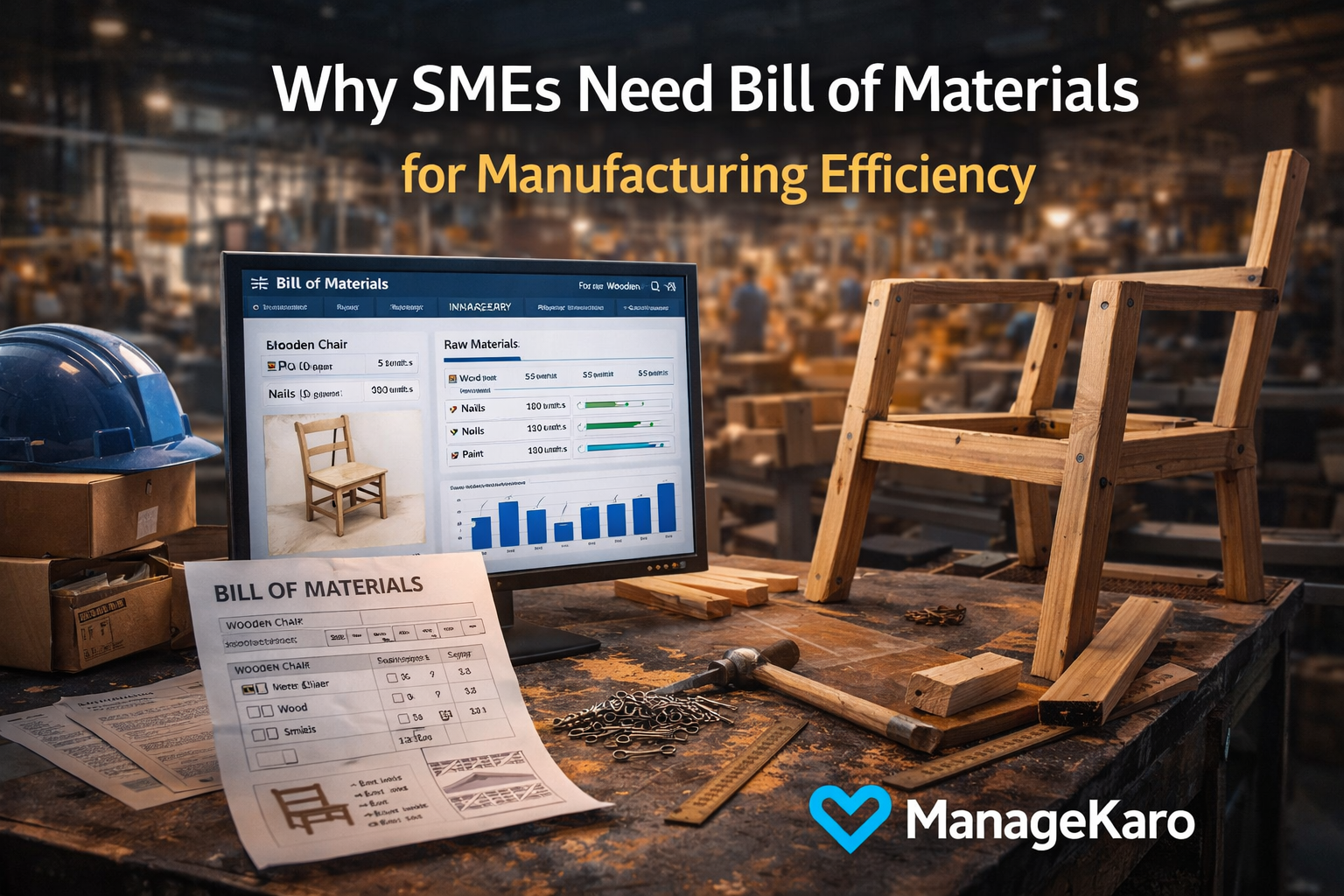
Product: Wooden Chair
Raw Materials:
- Wood — 5 units
- Nails — 10 units
- Paint — 1 unit
This becomes the production formula.
When manufacturing starts, the system automatically uses this BOM.
Why SMEs Struggle Without BOM
Manufacturing businesses without BOM face:
- Material shortages
- Incorrect production
- Manual calculations
- Inventory confusion
- Costing errors
These problems increase as production volume grows.
Benefits of Using Bill of Materials
1. Accurate Raw Material Planning
BOM helps businesses know:
- What materials are required
- How much is needed
- When to reorder
This prevents production delays.
2. Automated Production Workflow
With BOM:
- Materials deduct automatically
- Finished goods add automatically
- Inventory updates automatically
This reduces manual work.
3. Better Cost Control
BOM helps calculate:
- Material cost
- Production cost
- Product cost
This improves pricing decisions.
4. Reduced Production Errors
Without BOM, production depends on manual decisions.
With BOM, production follows predefined rules.
This improves consistency.
5. Faster Manufacturing
BOM speeds up production by:
- Reducing manual calculations
- Improving planning
- Streamlining workflow
How ManageKaro BOM Manufacturing Works
Step 1
Add raw materials
Step 2
Create finished product
Step 3
Define Bill of Materials
Step 4
Start production
ManageKaro automatically:
- Deducts raw materials
- Adds finished goods
- Updates costing
- Updates inventory
Everything is automated.
Example: Clothing Manufacturer
Product: Shirt
Raw Materials:
- Fabric — 2 meters
- Buttons — 5 units
- Label — 1 unit
Production: 100 shirts
System automatically:
- Deducts fabric
- Deducts buttons
- Adds 100 shirts
- Calculates cost
No manual tracking required.
Who Should Use BOM Manufacturing
BOM is ideal for:
- Furniture manufacturers
- Textile manufacturers
- Food production businesses
- Electronics manufacturers
- Plastic manufacturers
- Workshops
- Small factories
Any business producing finished goods benefits from BOM.
Why Pakistani SMEs Are Adopting BOM Systems
Manufacturing SMEs in Pakistan are moving toward BOM-based systems because:
- Production is increasing
- Manual errors are costly
- Competition is growing
- Automation improves efficiency
BOM helps businesses scale production smoothly.
Final Thoughts
Manufacturing businesses need structured production workflows to grow.
Bill of Materials helps SMEs:
- Improve planning
- Reduce wastage
- Improve costing
- Scale production
The ManageKaro BOM manufacturing feature helps businesses automate production and improve operational efficiency.
As manufacturing grows in 2026, BOM-based production is becoming essential for SMEs.