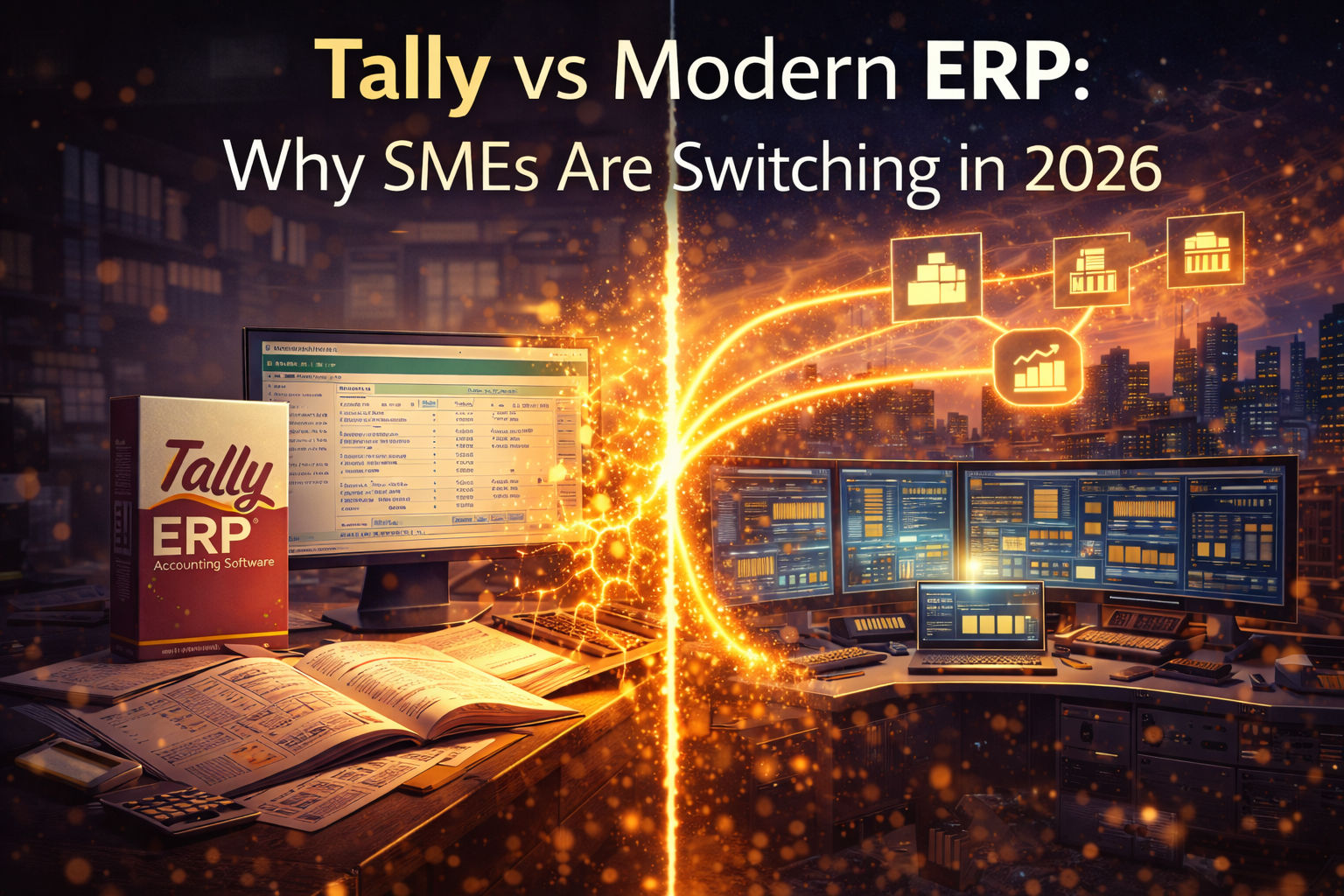
For decades, Tally has been one of the most widely used accounting tools for businesses in South Asia. Many small and medium-sized enterprises (SMEs) in Pakistan started their financial management journey using Tally. However, as businesses grow and operations become more complex, many companies are realizing that traditional accounting software alone is no longer enough. In 2026, a growing number of SMEs are transitioning from Tally to modern ERP systems (Tally vs ERP) to manage their operations more efficiently.
Let’s explore why this shift is happening.
What Tally Is Designed For
Tally is primarily an accounting software.
Its main strengths include:
- financial accounting
- ledger management
- tax reporting
- profit and loss statements
- financial compliance
For businesses focused mainly on accounting and bookkeeping, Tally has historically been a reliable tool.
However, Tally was not originally designed to manage the entire business operation.
What Modern ERP Systems Do
Modern ERP (Enterprise Resource Planning) systems integrate multiple business functions into a single platform.
A typical ERP system manages:
- inventory management
- billing and invoicing
- accounting
- purchase and supplier management
- multi-branch operations
- staff access control
- real-time business analytics
Instead of using multiple disconnected tools, ERP systems centralize business data.
Key Differences Between Tally and ERP
| Feature | Tally | Modern ERP |
|---|---|---|
| Accounting | ✔ | ✔ |
| Inventory Management | Limited | Advanced |
| Billing & POS | Limited | Integrated |
| Multi-Branch Management | Limited | Full |
| Supplier & Purchase Tracking | Basic | Advanced |
| Business Analytics | Basic | Real-time |
| Scalability | Moderate | High |
Tally focuses primarily on financial accounting, while ERP systems manage complete business operations.
Why SMEs Are Moving Beyond Tally
Several factors are driving the shift toward ERP systems.
1. Inventory Complexity
As businesses expand, inventory management becomes more challenging.
ERP systems provide real-time stock visibility, while traditional accounting tools often require additional manual tracking.
2. Multi-Branch Operations
Many SMEs now operate across multiple locations.
ERP systems allow centralized monitoring of all branches, which simplifies operations and reporting.
3. Real-Time Business Insights
Modern businesses require fast decision-making.
ERP systems provide dashboards and analytics that allow business owners to monitor performance instantly.
4. Operational Integration
ERP platforms integrate accounting, inventory, billing, and purchasing in one system.
This eliminates the need for multiple disconnected tools.
When Tally Still Makes Sense
Tally can still work well for businesses that:
- focus primarily on accounting
- operate from a single location
- have simple inventory structures
- do not require operational integration
For these businesses, accounting software alone may still be sufficient.
When Businesses Should Consider ERP
Businesses should consider upgrading to ERP when:
- inventory becomes difficult to track
- multiple branches exist
- business reports require manual consolidation
- operational complexity increases
ERP systems are built to support business growth.
Final Thoughts
The shift from Tally to modern ERP systems reflects the changing needs of SMEs.
While Tally remains a powerful accounting tool, modern businesses increasingly require integrated systems that manage operations, inventory, and financial data together.
In 2026, SMEs that adopt scalable business systems are better positioned to grow efficiently and compete in rapidly evolving markets.