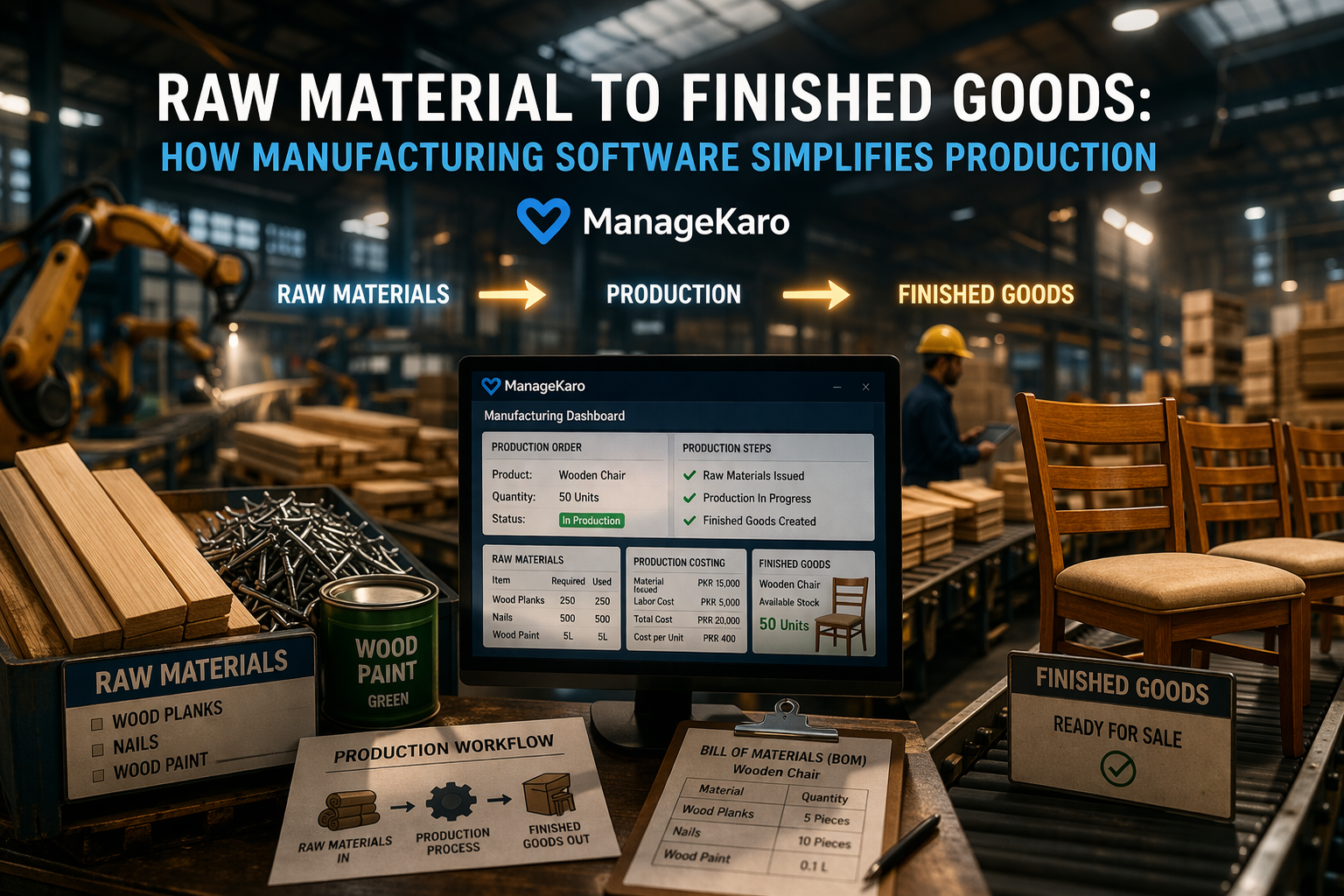
Manufacturing businesses often struggle to manage the journey from raw materials to finished goods. As production grows, tracking materials, managing workflows, and calculating costs manually becomes difficult. This is where manufacturing software plays a critical role. Modern solutions like ManageKaro help businesses manage the complete production lifecycle — from raw material entry to finished product creation — in one unified system.
The Challenge of Managing Raw Materials Manually
Many manufacturing SMEs still rely on:
- Excel sheets
- Manual stock tracking
- Paper-based production records
- Manual costing calculations
These manual methods create common problems:
- Raw material shortages
- Overproduction
- Inventory mismatch
- Incorrect costing
- Production delays
As business grows, these issues become harder to control.
What Is Raw Material to Finished Goods Workflow
Manufacturing businesses convert:
Raw Materials → Work in Progress → Finished Goods
For example:
Furniture Manufacturing
Raw Materials:
- Wood
- Nails
- Paint
Finished Product:
- Chair
Without manufacturing software, tracking this process becomes complex.
How Manufacturing Software Simplifies Production
Manufacturing software automates the complete workflow:
Step 1
Add Raw Materials
Step 2
Create Finished Product
Step 3
Define Production Requirements
Step 4
Start Production
System automatically:
- Deducts raw materials
- Adds finished goods
- Updates costing
- Updates inventory
Everything happens automatically.
Benefits of Raw Material to Finished Goods Automation
1. Better Inventory Control
Manufacturing software automatically tracks:
- Raw materials
- Work in progress
- Finished goods
This prevents inventory confusion.
2. Accurate Production Costing
Businesses can track:
- Material cost
- Production cost
- Product cost
This improves pricing decisions.
3. Reduced Production Errors
Automation reduces:
- Manual calculations
- Tracking errors
- Inventory mistakes
This improves accuracy.
4. Faster Production Planning
Businesses can:
- Plan production
- Track material availability
- Avoid delays
This improves operational efficiency.
How ManageKaro Manufacturing Feature Helps
ManageKaro provides:
- Raw material tracking
- Production management
- Finished goods tracking
- Automatic costing
- Inventory synchronization
This allows businesses to manage production smoothly.
Example: Clothing Manufacturer
Raw Materials:
- Fabric
- Buttons
- Labels
Production:
- 200 shirts
System automatically:
- Deducts fabric
- Deducts buttons
- Adds finished shirts
- Updates inventory
Everything is automated.
Who Should Use Manufacturing Software
Manufacturing software is ideal for:
- Furniture manufacturers
- Textile businesses
- Food manufacturers
- Electronics manufacturers
- Plastic manufacturers
- Small factories
- Workshops
Any business converting raw materials into finished goods benefits.
Why SMEs Are Moving to Manufacturing Software
Manufacturing SMEs are adopting software because:
- Manual systems are inefficient
- Production complexity is increasing
- Inventory management is difficult
- Growth requires automation
Manufacturing software helps businesses scale efficiently.
Final Thoughts
Managing raw materials to finished goods manually becomes difficult as businesses grow.
Manufacturing software helps SMEs:
- Automate production
- Improve costing
- Reduce errors
- Scale operations
The ManageKaro manufacturing feature helps businesses manage production efficiently and grow confidently.