Most retail businesses start with POS (Point of Sale) software because it simplifies billing and daily transactions. At the beginning, POS systems feel like the perfect solution. They are fast, easy to use, and require minimal setup.
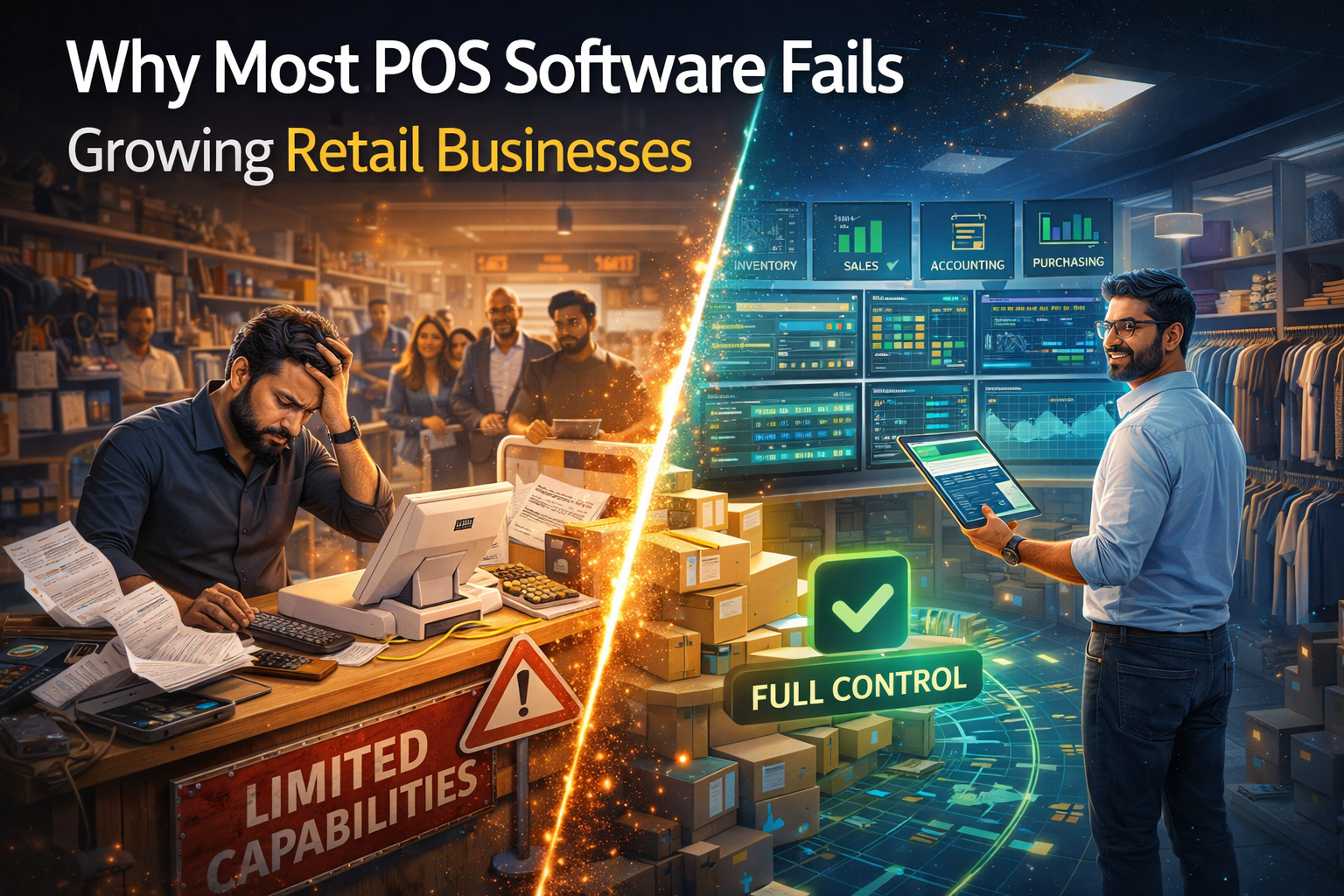
However, as retail businesses grow, many owners begin to realize a critical limitation:👉 POS software is not designed to run an entire business.
This is why many growing retailers eventually move beyond POS systems.
Let’s break down why.
1. POS Focuses on Transactions, Not Operations
POS systems are built primarily for:
- billing
- checkout
- basic sales tracking
But retail businesses require much more than just transactions.
They need to manage:
- inventory across locations
- supplier purchases
- stock movement
- business performance
POS systems often lack the depth needed for full operational control.
2. Inventory Visibility Becomes a Major Problem
As product lines grow, inventory becomes harder to manage.
Retailers start facing:
- stock mismatches
- out-of-stock situations
- overstocking
- lack of real-time updates
Basic POS systems struggle to provide real-time inventory tracking across multiple locations.
3. No Centralized Multi-Branch Management
When a business expands to multiple stores, managing them separately becomes inefficient.
Retailers often face:
- inconsistent data
- delayed reporting
- lack of centralized control
Modern business systems allow businesses to monitor all branches in one place.
4. Limited Business Insights
POS reports are often limited to:
- daily sales
- basic revenue summaries
But growing businesses need deeper insights like:
- profit margins
- product performance
- sales trends
- branch comparisons
Without these insights, decision-making becomes reactive instead of strategic.
5. Manual Work Increases Over Time
Many businesses using POS systems rely on manual processes such as:
- updating inventory separately
- managing supplier data externally
- reconciling reports manually
This increases workload and introduces errors.
6. Lack of Integration Across Business Functions
Retail businesses need systems that connect:
- inventory
- billing
- accounting
- purchasing
- reporting
POS systems often operate in isolation, forcing businesses to use multiple disconnected tools.
7. Growth Gets Slowed Down
The biggest issue is this:
👉 Your business grows, but your system doesn’t.
When systems cannot support operational complexity, they become a bottleneck instead of an asset.
What Growing Retail Businesses Actually Need
Modern retail businesses require integrated business management systems that go beyond billing.
These systems combine:
- POS + inventory
- accounting
- supplier management
- analytics
- multi-branch control
This allows businesses to operate efficiently while scaling.
Final Thoughts
POS software is a great starting point for small retail businesses.
But as operations expand, relying solely on POS systems can create limitations.
Growing retailers need systems that provide full visibility, control, and scalability across their business.
Choosing the right software is not just about managing sales — it’s about enabling growth.