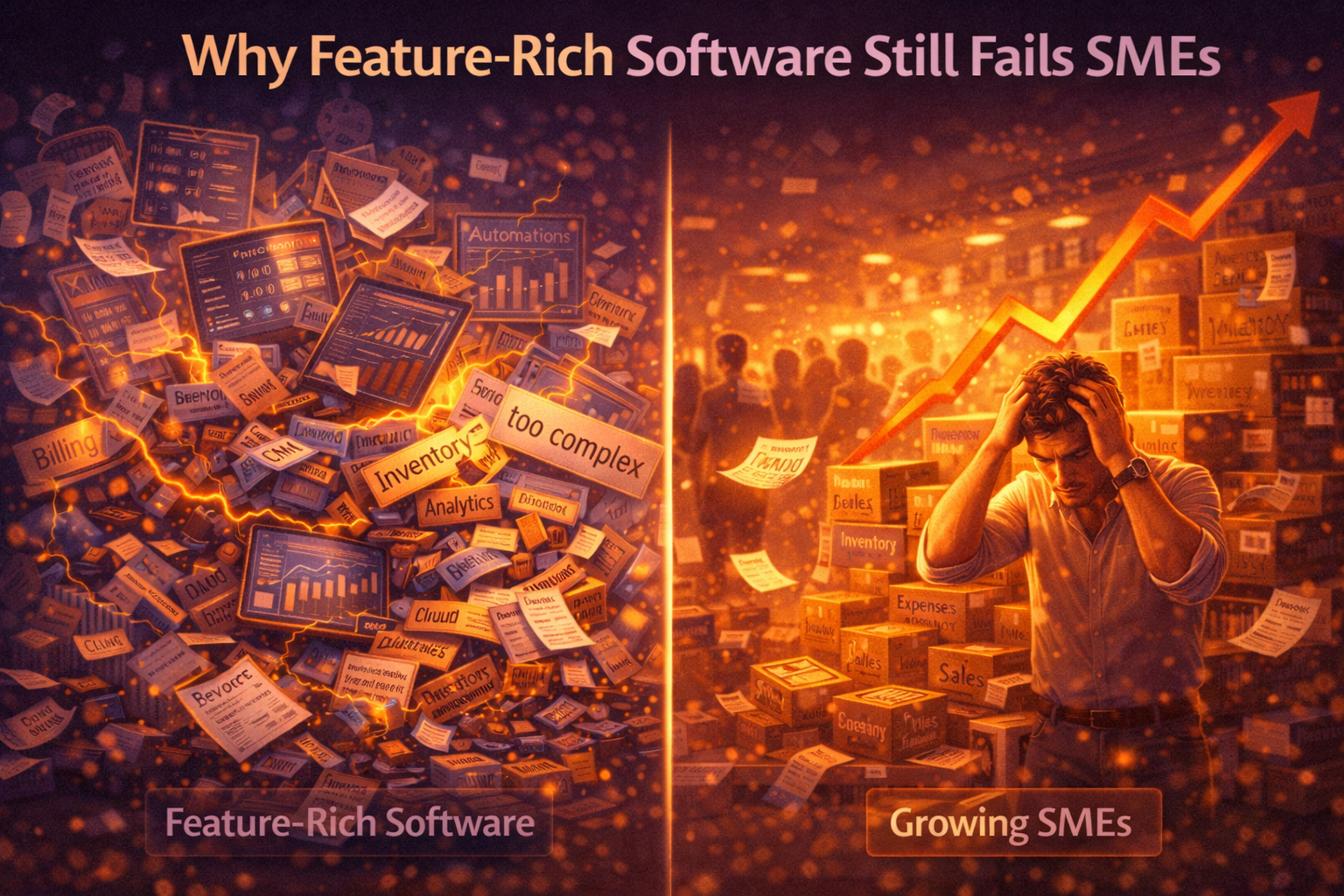
When SMEs look for business software, they often compare tools by one simple metric:
Which one has more features?
More reports.
More modules.
More settings.
Yet despite choosing “feature-rich” software, many SMEs still struggle with confusion, inefficiency, and slow growth.
The problem isn’t a lack of features.
The problem is how those features fit (or don’t fit) real business operations.
The Feature Trap: Why More Isn’t Always Better
Feature-rich software promises to do everything. But for growing SMEs, this often creates new problems instead of solving old ones.
Here’s why.
1. Features Increase Complexity, Not Clarity
As businesses grow, owners need:
- Faster understanding
- Quicker decisions
- Less mental load
Feature-heavy software often does the opposite:
- Too many menus
- Too many options
- Too many reports
Instead of clarity, SMEs get overwhelmed — and important signals get buried.
2. Features Exist in Silos
Many tools advertise:
- Billing features
- Inventory features
- Accounting features
But these features often don’t talk to each other properly.
The result:
- Sales don’t explain profit
- Inventory doesn’t explain cash flow
- Expenses don’t explain risk
SMEs still have to connect the dots manually.
3. SMEs Don’t Need “Everything” — They Need the Right Things
Most SMEs don’t need:
- Advanced configurations
- Enterprise-level controls
- Rarely used modules
They need:
- Clear profit visibility
- Cash flow awareness
- Inventory clarity
- Fewer mistakes
Feature-rich software often prioritizes breadth over usefulness.
4. More Features Mean More Manual Work
Ironically, many feature-heavy tools:
- Require more setup
- Need frequent adjustments
- Depend on manual corrections
Instead of saving time, they:
- Increase data entry
- Increase reconciliation
- Increase reliance on Excel
The business owner ends up managing the software — not the business.
5. Reports Look Powerful but Don’t Drive Action
Feature-rich software often provides dozens of reports.
But SMEs still ask:
- What should I fix today?
- Where am I losing money?
- What decision matters most right now?
When reports don’t answer these questions, features become noise.
6. Training Becomes a Bottleneck
As teams grow:
- New staff need onboarding
- Errors increase
- Usage becomes inconsistent
Complex software slows adoption and increases dependency on a few “expert users,” creating operational risk.
7. Growth Exposes the Weakness
At small scale, feature-rich software feels impressive.
At growth stage:
- Inventory grows
- Transactions increase
- Cash pressure rises
That’s when SMEs realize:
“The software does a lot — but it doesn’t help me run the business better.”
What SMEs Actually Need Instead
Growing SMEs need software that:
- Explains the business, not just records it
- Connects sales, inventory, expenses, and cash
- Highlights risks early
- Reduces decisions to what truly matters
- Scales without becoming harder to use
In short: systems, not features.
Why ManageKaro Takes a Different Approach
ManageKaro is not built to win feature comparisons.
It’s built to reduce business confusion.
It focuses on:
- Connected data, not isolated modules
- Cash-aware insights, not static reports
- Inventory intelligence, not just stock counts
- Simplicity that scales with growth
For SMEs, this means:
- Less manual work
- Fewer tools
- Clearer decisions
- More confidence as the business grows
Final Thoughts
Feature-rich software doesn’t fail because it lacks capability.
It fails because SMEs don’t need complexity — they need clarity.
The best software isn’t the one with the longest checklist.
It’s the one that helps business owners understand their numbers and act with confidence.
That’s where ManageKaro fits in.