Many retail businesses in Pakistan start with a POS system.
It handles billing, prints receipts, and records sales.
But as the business grows, many owners realize something important:
A POS system alone is not enough.
This is where ERP systems come in.
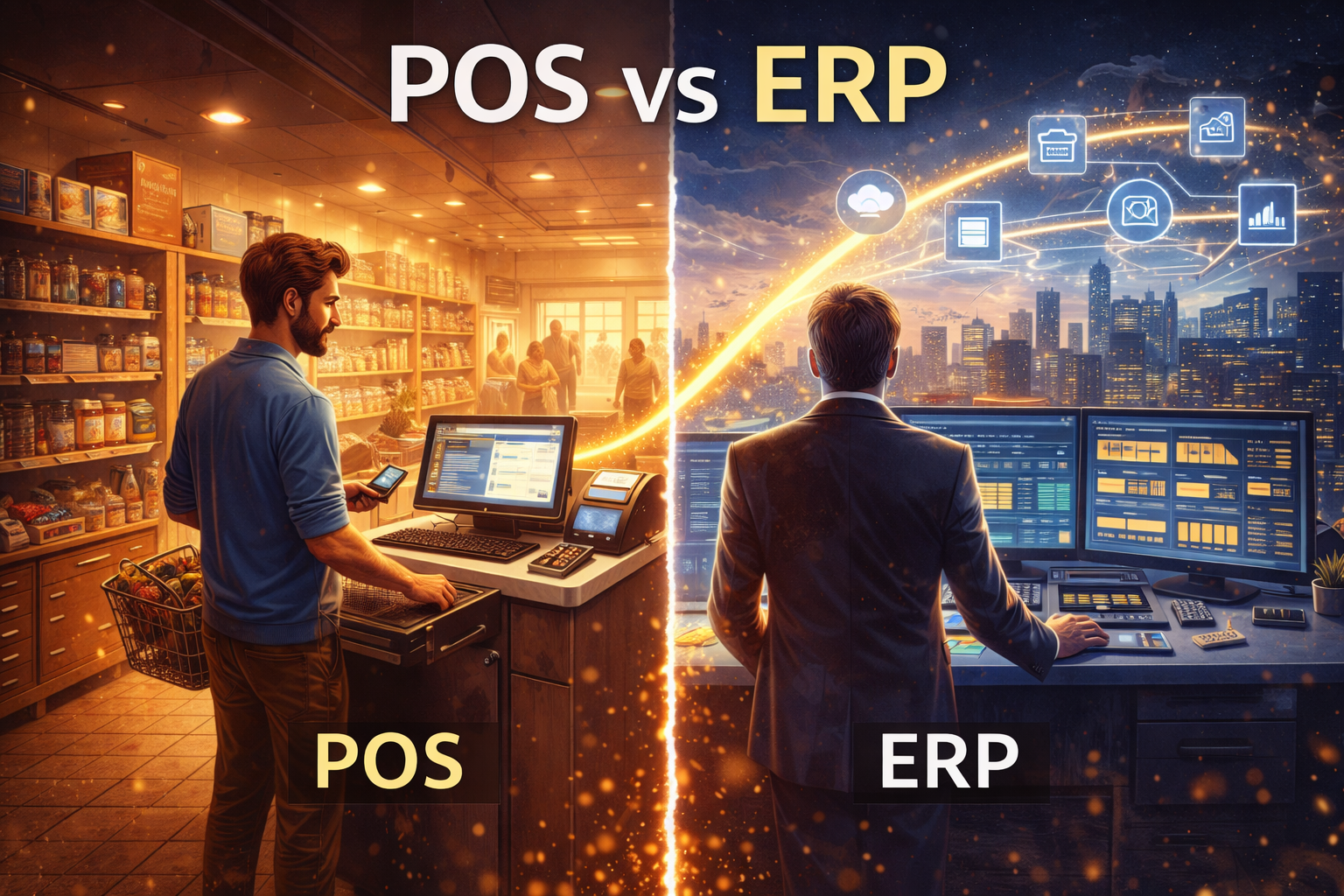
Understanding the difference between POS vs ERP helps businesses choose the right technology for growth.
What Is a POS System?
A POS (Point of Sale) system focuses on transactions.
It helps businesses:
- Process customer payments
- Generate invoices
- Scan barcodes
- Record daily sales
POS systems are ideal for:
- Small retail stores
- Grocery shops
- Pharmacies
- Cafes and restaurants
Their main purpose is fast checkout and transaction recording.
What Is an ERP System?
ERP stands for Enterprise Resource Planning.
Unlike POS systems, ERP software manages the entire business operation.
ERP systems handle:
- Inventory management
- Purchasing and suppliers
- Accounting and finance
- Multi-branch operations
- Staff access control
- Business analytics
ERP connects all business processes into one system.
Key Difference Between POS and ERP
| Feature | POS System | ERP System |
|---|---|---|
| Billing | ✔ | ✔ |
| Inventory | Basic | Advanced |
| Accounting | Limited | Full |
| Multi-branch management | Limited | Strong |
| Business reporting | Basic | Advanced |
| Scalability | Low | High |
POS focuses on transactions.
ERP focuses on business management.
When POS Software Is Enough
A POS system may be sufficient if:
- You operate a single shop
- Inventory is small
- Reporting needs are simple
- Staff count is low
For micro businesses, POS works well.
When Businesses Need ERP
Businesses should consider ERP when:
- Multiple branches are involved
- Inventory management becomes complex
- Financial reporting is unclear
- Expansion is planned
- Data from multiple systems needs consolidation
ERP provides visibility and control.
Why Many Pakistani Retailers Start with POS
POS systems are:
- Easy to install
- Affordable
- Simple to operate
For early-stage businesses, they solve immediate billing needs.
But growth often exposes operational gaps.
Why Growing SMEs Move to ERP
Retail businesses expand quickly.
As operations grow, POS limitations appear:
- Inventory mismatches
- Manual financial consolidation
- Lack of branch visibility
- Limited analytics
ERP solves these problems by centralizing data.
Final Thoughts
Choosing between POS vs ERP depends on the stage of your business.
POS works well for small stores.
ERP becomes essential as operations expand.
Retailers who adopt structured systems early gain stronger control and clearer financial visibility.
In 2026, the businesses that scale efficiently are those with integrated systems.