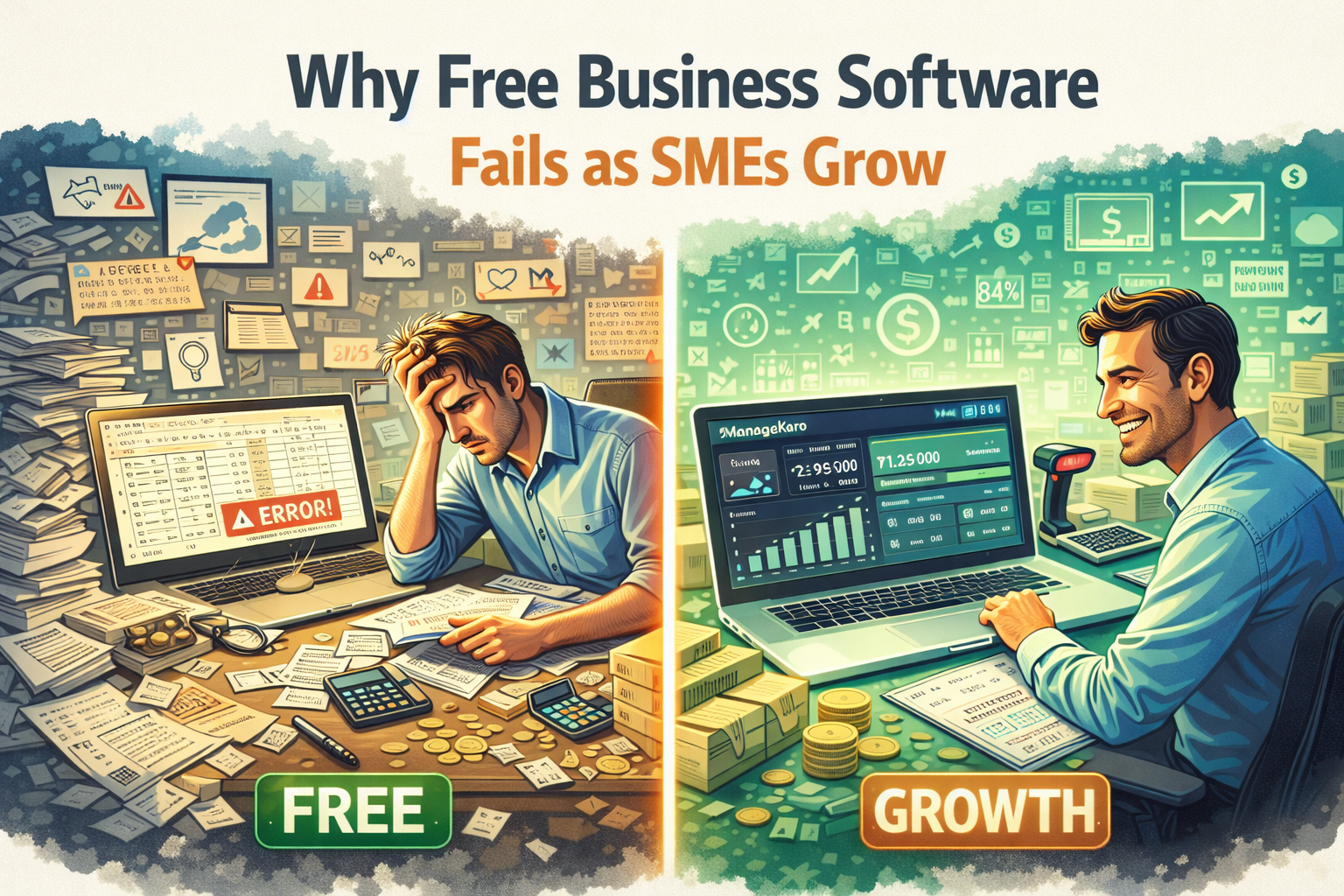
Free business software is often the first step for small businesses going digital. It helps with basic billing, simple expense tracking, or early recordkeeping. But as SMEs grow, many owners suddenly feel stuck — systems slow down, errors increase, and visibility disappears.
This isn’t bad luck. It’s a pattern.
Free business software is not designed for growth, and most SMEs outgrow it faster than they expect.
1. Free Software Breaks Under Higher Volume
As sales increase, free tools struggle with:
- Higher transaction volumes
- Larger inventories
- Multiple customers and suppliers
What once worked smoothly becomes slow and error-prone.
Growing SMEs need systems that handle scale — not just starters.
2. Manual Work Increases Instead of Decreasing
Free software often lacks automation.
As businesses grow, owners end up:
- Manually reconciling records
- Updating stock separately
- Calculating profits by hand
- Fixing data mismatches
Instead of saving time, free tools create more work.
3. No Real-Time Business Visibility
Most free tools provide:
- Basic reports
- Delayed summaries
- Limited insights
As a result, SMEs:
- Discover problems too late
- React instead of plan
- Miss early warning signs
Without real-time dashboards, growth becomes risky.
4. Inventory Errors Multiply
Inventory is where free software fails fastest.
Common issues include:
- Stock mismatches
- No low-stock alerts
- No tracking of slow-moving items
- Cash locked in dead stock
As product lines grow, these errors directly hurt profit and cash flow.
5. Accounting Becomes Messy
Free tools often require:
- Manual accounting entries
- Separate spreadsheets
- External accounting software
This leads to:
- Inconsistent records
- Higher error risk
- Stress during audits or tax season
Growing SMEs need accounting that updates automatically with every transaction.
6. Free Software Doesn’t Scale With Teams
As businesses add:
- Staff
- Counters
- Branches
Free tools struggle with:
- Access control
- Data consistency
- Multi-user workflows
What worked for one person fails for a team.
7. Hidden Costs Start Appearing
Although free software has no subscription cost, it creates hidden expenses:
- Time wasted
- Errors and rework
- Missed sales
- Poor decisions due to lack of data
At scale, these hidden costs are far more expensive than paid software.
Why Growing SMEs Switch to ManageKaro
ManageKaro is designed specifically for growth-stage SMEs.
It solves free-software limitations by offering:
- Automated billing and POS
- Real-time inventory tracking
- Expense and accounting automation
- Customer credit management
- Live dashboards for sales, profit, and cash flow
- Scalable workflows for teams
Instead of switching tools every year, SMEs grow smoothly on one platform.
Final Thoughts
Free business software is a great starting point — but it’s not a growth solution.
As SMEs expand, free tools fail quietly, creating chaos instead of control.
Successful businesses upgrade before problems become costly, not after.
With ManageKaro, SMEs gain clarity, automation, and confidence — exactly when growth demands it.